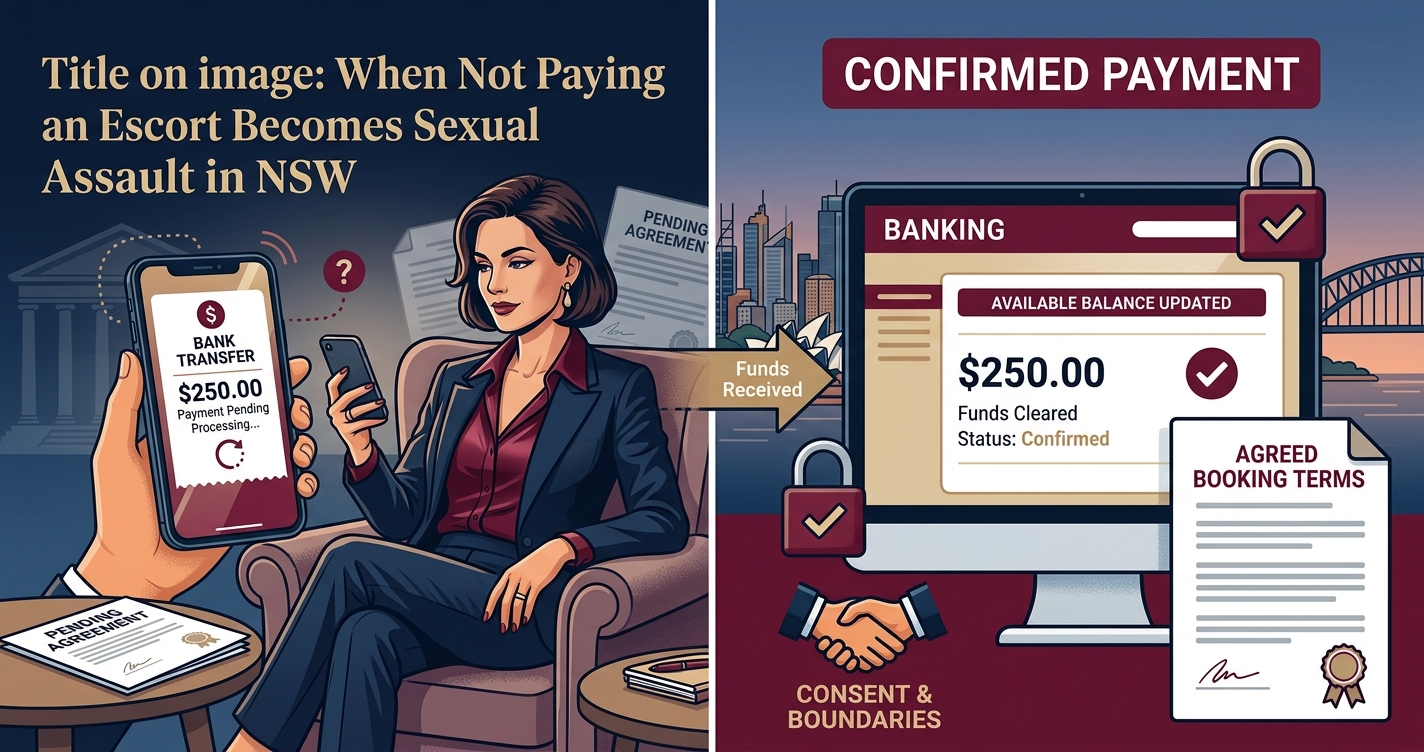
When Not Paying an Escort Becomes Sexual Assault in NSW
An Unpaid Case Happened in NSW
For years, an unpaid sex-work booking could be dismissed as a debt dispute: frustrating, costly and something to chase through civil channels. In New South Wales, that assumption can now be dangerously wrong.
A major prosecution involving Sydney sex worker Natasha Ambrose has put a much sharper legal line around payment and consent. Harjeet Saini, a regular client who had previously paid her, later showed what appeared to be proof of an electronic transfer during another booking. The money never arrived. Similar reports from other sex workers eventually revealed a wider pattern. Saini pleaded guilty to 11 sexual offences involving multiple women and was sentenced to six years in prison.
Why Payment Can Be Part of Consent
The key issue is not simply that a bill went unpaid. It is how consent was obtained.
Under section 61HJ(1)(k) of the NSW Crimes Act, fraudulent inducement is one of the circumstances in which consent may be absent. Legal advocates have argued that this can apply when a sex worker agrees to sexual services because a client dishonestly represents that the agreed payment has been or will be made.
A normal commercial disagreement and deliberately tricking someone into sex are not the same thing. The Saini case involved false representations of payment and repeated conduct, rather than an ordinary banking delay.
For clients browsing Australian escort listings, the practical rule is simple: negotiated terms matter. Payment, boundaries, timing and agreed services form part of the booking arrangement.
The Trust Problem Behind Electronic Payments
Electronic transfers make escort bookings convenient, but they can also create risk. A screenshot may look convincing while the actual funds are still absent.
Ambrose had reason to trust Saini because she had paid him successfully before. That history made the apparent transfer more believable. When the money failed to arrive, she described the impact as going beyond lost income: she felt deceived into sexual activity.
That is why payment confirmation matters. Sex workers may use safeguards such as checking cleared funds and keeping written records of booking terms. Readers seeking broader guidance can explore articles on Australian escort safety and etiquette.
What Clients Should Take From the Case
Good escort booking etiquette is straightforward:
- Agree on the terms before the appointment.
- Never fake or misrepresent payment confirmation.
- Do not pressure a worker while payment is unresolved.
- Respect boundaries exactly as negotiated.
- Treat consent as ongoing and specific.
These basics protect both sides and reduce avoidable disputes.
Why the Ruling Matters Beyond One Case
The case also exposed a wider problem. Some sex workers attempting to report fraudulent non-payment were initially treated as though they had only a civil dispute.
The Inner City Legal Centre has reported difficulties with frontline police recognising that dishonest promises of payment may raise sexual-offence issues under the NSW consent law. Its 2026 submission called for the legislation to make protection for sex workers even more explicit.
Sex workers are entitled to the same legal recognition of consent as anyone else. Providing commercial sexual services does not remove the right to say yes, no, stop, or “only on these agreed terms.”
For Australia's escort industry, the lesson is broader than one prosecution. Clear communication, genuine payment, and respect for negotiated conditions are fundamental to safer adult services.
Better Bookings Start With Clear Terms
The safest booking is one where nobody has to guess what was agreed. Clients should confirm the arrangement, use genuine payment methods and raise any banking problems immediately.
Sex workers can choose payment-verification and screening practices that suit their circumstances. Anyone wanting to understand how listings and booking expectations are presented can browse Australian escort profiles before making contact.
The NSW case sends a clear message: consent within paid sexual services remains specific, voluntary and connected to the circumstances on which the agreement was made.
This article provides general information and should not be treated as legal advice.
Frequently Asked Questions
Can refusing to pay an escort be sexual assault in NSW?
Potentially. The key issue is fraudulent inducement. If someone agrees to sexual activity because they were dishonestly led to believe that agreed payment would be made, the NSW consent law may apply. Not every payment dispute automatically becomes a sexual offence.
What is fraudulent inducement?
It is a legal concept involving consent obtained because of a dishonest inducement. In a sex-work context, a false representation about agreed payment may be relevant.
Should escorts accept screenshots as proof of payment?
That is a business and safety decision for each worker, but a screenshot is not the same as cleared funds. Confirming actual receipt can reduce payment risk.
Does being a sex worker change the right to consent?
No. Commercial sexual services do not remove a person's right to give, refuse or withdraw consent.