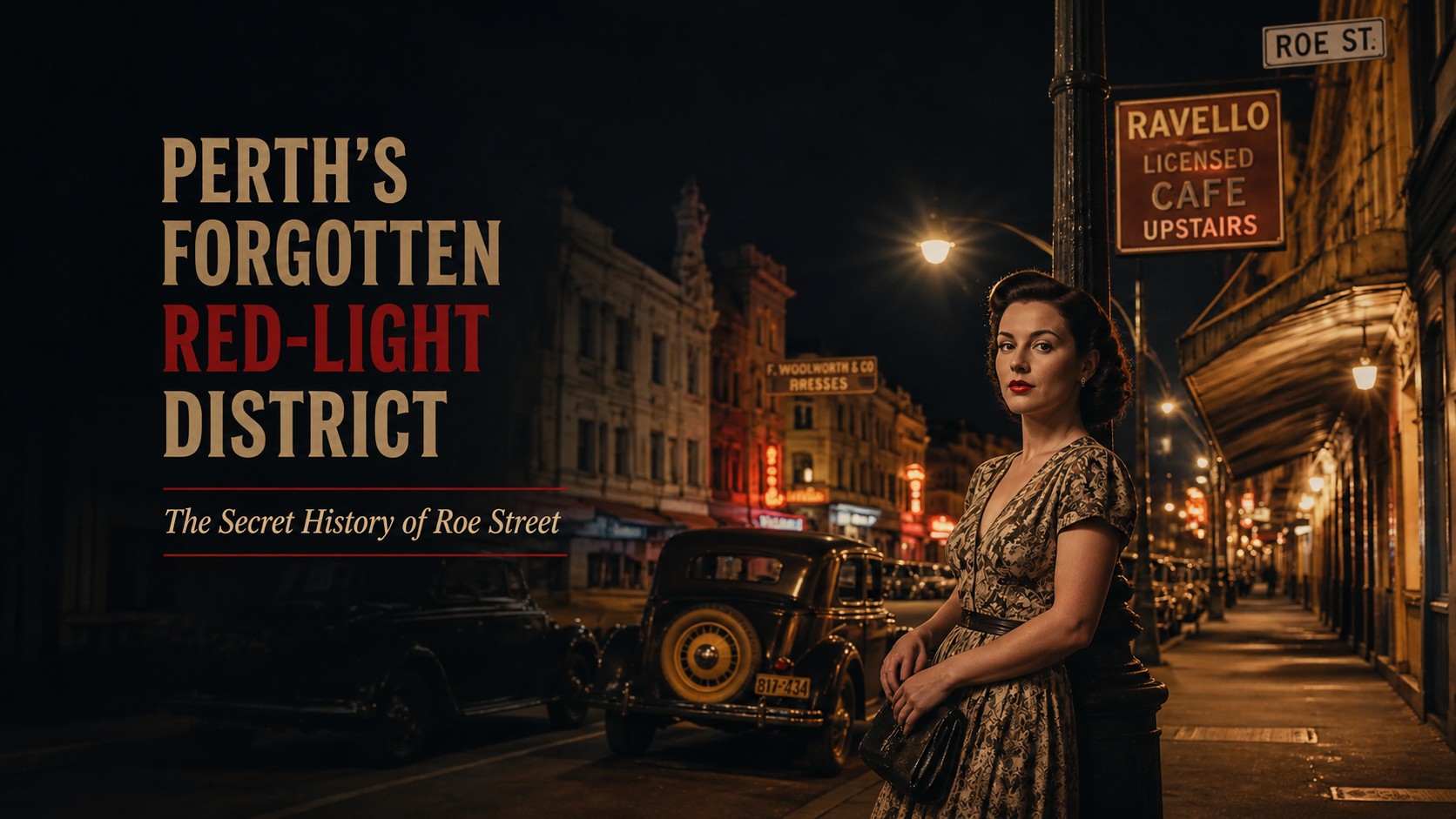
The Secret History of Perth’s Roe Street: The Red-Light District the City Forgot
Perth has always been rather good at presenting itself as respectable.
Beautiful beaches. Expensive houses. Mining fortunes. Men discussing property prices with the enthusiasm usually reserved for football finals.
Sex workers? Apparently, we're supposed to believe they arrived sometime after the invention of the internet.
Except they didn't.
Long before modern escort advertising, dating apps or discreet hotel appointments, Perth had an established red-light district right near the heart of the city.
It was called Roe Street.
And its history is considerably more interesting than the version of Perth found in tourism brochures.
When Roe Street Was Perth's Red-Light District
During the early twentieth century, Roe Street became one of Perth's best-known centres of prostitution.
Situated near Perth Railway Station, the district contained brothels that operated for decades despite prostitution being officially illegal.
The authorities largely tolerated the businesses while attempting to control where and how they operated.
A wonderfully convenient arrangement, really.
The city could acknowledge that sex work existed, benefit from keeping it contained, and still maintain an appropriately shocked expression whenever somebody mentioned it in polite company.
Some establishments became known for their French madams, helping earn the district the nickname Rue de Roe.
One notable figure was Marie Monnier, who arrived in Perth from France in 1902 and later became an influential brothel operator.
Historian Leigh Straw explored her life in The Petticoat Parade: Madam Monnier and the Roe Street Brothels.
But the real story isn't simply that Perth once had brothels.
It's how much effort the city devoted to making them invisible.
The Women Behind the Curtains
One of the strangest details about Roe Street concerns its fences.
Women working in the brothels could be seen from trains approaching Perth Railway Station.
This apparently offended the respectable sensibilities of people who preferred their city without visible evidence of its adult economy.
So fences were erected.
Then they became higher.
Not because the businesses had disappeared, but because the public wasn't supposed to see them.
Perth had effectively invented an early version of hiding an inconvenient browser tab.
The industry remained. The customers remained. The money continued changing hands.
Only the view improved.
That contradiction says more about the city's moral priorities than any scandalous newspaper headline from the period.
Meet Joan: A Perth Sex Worker Who Refused to Become a Footnote
Fortunately, not every woman involved in Roe Street disappeared from history.
Joan St Louis left behind an extraordinary account of her working life.
In 1988, she recorded an oral history for the State Library of Western Australia, requesting that it remain private until after her death.
She died in 1994.
Her story was later brought to a wider audience through ABC reporting and the State Library's historical collection.
Joan had worked in Kalgoorlie before moving to Perth during World War II.
By 1941, she was working in one of Roe Street's brothels.
Her description of the workplace is surprisingly ordinary.
There were bedrooms, cleaning staff, a cook and established working hours.
Not quite the mysterious underground world imagined by people who have watched too many crime dramas.
The hours, however, were exhausting.
Joan recalled starting around 10am, taking breaks during the day and sometimes working until the early hours of the morning.
Eventually, she ran brothels herself.
At one stage, she managed two houses employing eleven women.
Some were married. Others had separated from their partners. Some had children to support.
They weren't characters invented to decorate a sensational newspaper story.
They were working women with bills, families and complicated lives.
And according to Joan, the primary motivation was refreshingly straightforward.
Money.
A concept that apparently becomes morally fascinating only when women earn it through sex work.
When Warships Meant Business
World War II brought an extraordinary variety of visitors through Western Australia.
Servicemen from different countries passed through Perth and Fremantle, creating busy periods for Roe Street's businesses.
Joan remembered American naval arrivals being particularly lucrative.
She also recalled that some visiting military groups caused enough trouble that the brothels occasionally closed their doors.
It wasn't exactly the romantic wartime atmosphere celebrated in old Hollywood films.
But it was part of the city's wartime economy.
And it challenges a familiar historical habit: enthusiastically documenting soldiers, ships and military spending while treating the women who serviced that economy as an embarrassing administrative detail.
Historians can tell us an extraordinary amount about wartime logistics.
The women earning a living alongside those logistics deserve a chapter too.
What Roe Street Reveals About the Escort Industry
One particularly revealing detail from Joan's account concerns boundaries.
Women working in her establishments could refuse customers they didn't feel comfortable accepting.
Payment was generally collected in advance, and workers had established arrangements with the houses.
That doesn't mean Roe Street was an ideal workplace.
Its history involved stigma, restrictive policing, limited freedoms and working conditions that deserve serious scrutiny.
Joan herself described how sex workers in Kalgoorlie faced restrictions on ordinary activities, including visiting certain public places.
But her account challenges the assumption that professional boundaries and organised working practices are inventions of the modern escort industry.
They aren't.
The circumstances have changed enormously, but the importance of communication, discretion and personal choice remains familiar.
Modern discussions about Perth escort experiences naturally look very different from Joan's wartime recollections.
Yet the underlying lesson is surprisingly consistent.
An intimate commercial arrangement doesn't eliminate the fact that two human beings are involved.
And neither money nor social status automatically entitles one person to ignore the other's limits.
How Perth Erased Its Most Notorious Street
By 1958, Roe Street's brothels had been closed.
Redevelopment and road infrastructure changes subsequently transformed the surrounding area.
Many of the buildings disappeared.
Today, little remains to indicate how important the district once was to Perth's social history.
The physical disappearance is understandable. Cities change.
But historical amnesia is something else.
When a city demolishes a building, it removes bricks and timber.
When it forgets the people who worked there, it removes an uncomfortable part of its identity.
That's why Joan's oral history matters.
Without accounts like hers, Roe Street risks becoming nothing more than an amusing historical curiosity about naughty things happening in old Perth.
And frankly, the women deserve better than that.
Perth Has Changed. Human Nature Hasn't Quite Kept Up.
Nobody should confuse Roe Street's history with the modern escort industry.
The technology, working arrangements, legal environment and social expectations have changed considerably.
Today, discussions about Perth's escort industry often involve online advertising, independent arrangements, privacy and the occasional spectacularly awkward encounter.
But one feature of the city's relationship with adult entertainment has proved remarkably durable.
The fascination.
And the discomfort.
Australia has spent generations pretending that adult sexuality belongs somewhere discreetly out of sight, preferably while continuing to consume the services, stories and entertainment associated with it.
Perth certainly didn't invent that contradiction.
It just built some impressively tall fences around it.
Other Australian cities have wrestled with their own versions of the same problem. The history of Adelaide's Hanson Road red-light district offers another example of how cities struggle to reconcile their public image with their adult industries.
What makes Roe Street particularly fascinating is that we have someone like Joan to remind us what happened behind the respectable façade.
Not a politician.
Not a police officer.
Not an outraged neighbour writing to the newspaper.
A woman who actually worked there.
And perhaps that's the most valuable thing about revisiting Perth's forgotten red-light district.
For once, the people who usually get talked about are allowed to do some of the talking.
Roe Street may have disappeared.
But Perth's history looks considerably more interesting when we stop pretending it was never there.