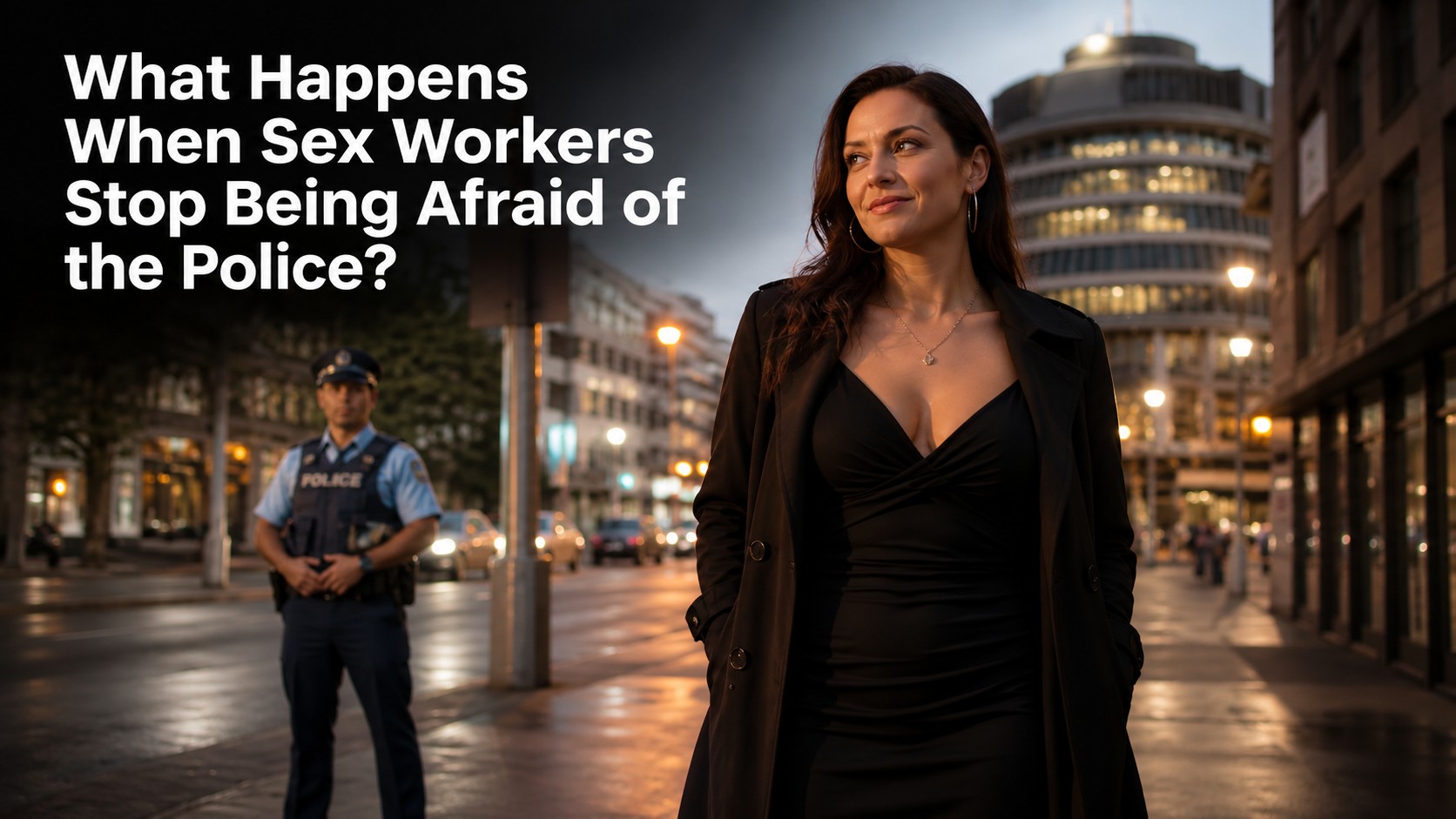
What Happens When Sex Workers Stop Being Afraid of the Police?
What Happens When Sex Workers Stop Being Afraid of the Police?
New Zealand changed its sex work laws more than 20 years ago. But perhaps the biggest change wasn't what happened in Parliament. It was what happened when someone finally felt safe enough to pick up the phone and call the police.
Imagine being robbed at work.
You know who did it. You know where it happened. You might even have their phone number.
But instead of calling the police, you sit there wondering whether reporting the crime will somehow get you into trouble.
Welcome to the wonderfully backwards world sex workers once had to navigate.
For years, that was a genuine concern in New Zealand. And in plenty of other countries, it still is.
Which raises an awkward question: what's the point of having police if the people who need them are too frightened to call?
Wellington Changed the Law. People Took a Little Longer.
Wellington loves a good political debate. Give this city a controversial issue, and someone will probably organise a committee, a consultation and three strongly worded opinion pieces before lunch.
But back in 2003, Parliament actually did something remarkable.
New Zealand decriminalised sex work.
The New Zealand Prostitutes' Collective (NZPC), founded in 1987, had spent years campaigning for change. Its work helped shift the conversation away from treating sex workers as criminals and towards recognising their rights.
Suddenly, the person selling a service wasn't automatically the problem.
Quite a concept.
Of course, changing the law didn't instantly turn every police officer into a sympathetic listener or every member of the public into an enlightened thinker.
Old prejudices don't disappear just because somebody signs a piece of legislation.
But something important began to shift.
Sex workers had more room to say no, set boundaries and report crimes without fearing prosecution simply for doing their jobs.
And that changed the conversation.
Sometimes the Biggest Change Is Being Taken Seriously
One story from New Zealand sex worker research has always struck me as particularly revealing.
A sex worker, identified as Moana, was drugged during a booking.
She was frightened about reporting what had happened, especially the possibility of ending up in court and being exposed.
So she contacted NZPC.
Rather than being pushed into an intimidating process alone, she received support. A police officer even arranged to meet her away from the public reception area.
That might sound like a small courtesy.
It wasn't.
Think about it. A woman had experienced something frightening, and one of her biggest concerns was whether seeking help would make things worse.
She didn't need a lecture about her career choices.
She needed someone to take her seriously.
And for once, that was exactly the point.
Apparently, Sex Workers Are People Too
Here's where the whole debate gets a little ridiculous.
If a customer assaults a bartender, most reasonable people don't ask whether serving alcohol was a sensible career choice.
If a taxi driver is robbed, nobody suggests they should have expected it because they work late nights.
But introduce the words sex worker, and suddenly some people become amateur philosophers.
Wasn't it risky? Shouldn't she have known better? Isn't that just part of the job?
No. It isn't.
And frankly, those questions say considerably more about the people asking them than about the woman who was hurt.
Being paid for someone's time doesn't mean purchasing their rights, their privacy or their ability to say no.
The same applies whether someone works independently, in an agency or through a professional New Zealand escort service.
It's a fairly uncomplicated principle.
Somehow, society has managed to complicate it for decades.
Even the Police Had to Learn a Few Things
One of the more encouraging developments in New Zealand was the cooperation between NZPC and the police.
They worked together on guidance to help sex workers report sexual assault and understand what to expect.
There was also training designed to improve officers' responses.
Imagine that.
Instead of treating sex workers as a problem to be managed, the police actually listened to people who understood the industry.
Revolutionary stuff.
It also makes practical sense.
Someone who feels respected is more likely to report a threatening client. Someone who expects humiliation or punishment is more likely to stay silent.
And silence is wonderful news for people who think they can get away with behaving badly.
It's considerably less wonderful for everyone else.
The Law Changed. The Idiots Didn't Disappear.
Now, before anyone starts polishing New Zealand's international halo, let's be clear about something.
Decriminalisation hasn't made every escort booking safe.
Some clients still lie, intimidate, steal, or believe that paying money makes them the managing director of another person's body.
It doesn't.
Recent international research comparing sex workers' experiences in New Zealand, Scotland and Ireland suggests that legal systems make a real difference to how comfortable workers feel approaching police.
But the research doesn't claim New Zealand has discovered a magical cure for human stupidity.
And that's probably the most sensible conclusion.
A law can give someone the right to report violence. It can't guarantee that every person will behave decently.
For Wellington escorts, professional boundaries and personal safety remain important, just as they do elsewhere in the country.
And let's not forget that some migrant workers face additional legal restrictions and vulnerabilities.
So no, the system isn't perfect.
Anyone claiming otherwise probably hasn't spoken to enough people working in it.
Maybe We Should Stop Acting So Surprised
What I find most interesting about New Zealand's approach isn't that sex workers gained some extraordinary new privilege.
It's that they gained more of something most people barely think about.
The ability to ask for help without automatically being treated as the problem.
That's hardly a glamorous political achievement.
You can't cut a ribbon around it. It won't attract tourists. And nobody is going to put Our Sex Workers Can Report Crime on a Wellington souvenir magnet.
Although, come to think of it, that might be more interesting than another fridge magnet featuring the Beehive.
The point is simple.
When people trust the police enough to report violence, everyone benefits.
When they don't, the people most likely to celebrate are the ones causing the trouble.
New Zealand still faces stigma, bad clients, and poor judgement. It probably never will.
But it has shown that treating sex workers as people with rights makes a difference.
And really, shouldn't that have been obvious all along?